Showing posts with label forex. Show all posts

Tuesday, June 3, 2014

How to Trade Gold in an Oversold Market

The Relative Strength Index (RSI) is a poplar oscillating indicator designed to help us determine market momentum and pinpoint entries during a variety of trading conditions. However, depending on if the market is ranging or trending, traders should approach the overbought and oversold RSI values seen below very differently. Today we are going to review the trend developing in gold (XAU/USD), and how RSI can be used to enter into strong moving trends.
How to Trade Gold in an Oversold Market
RSI Crossovers
Normally traders will use the RSI indicator for what is known as a crossover. A crossover occurs when RSI swings through an overbought or oversold value, then cross back through the selected value. The idea behind this is to enter new trades when momentum returns to the market. This can be a great strategy and normally will work when the market is in a range bound environment used in conjuncture with a support and resistance levels. Ultimately, traders using crossovers are looking to buy when prices are low or sell when prices are relatively high.
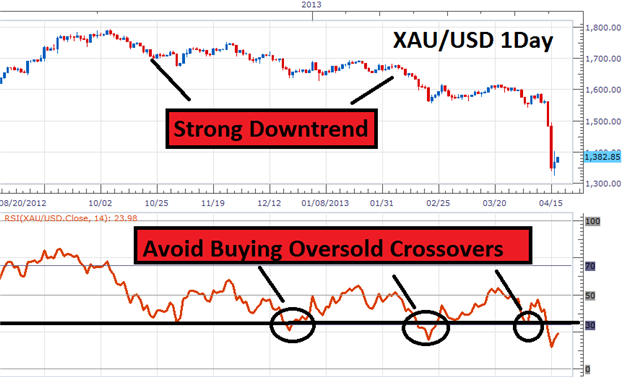
However, at the moment this strategy is not conducive for trading strong trends such as gold. Due to the market being in a downtrend, traders should absolutely avoid entering trades when RSI crosses back above oversold values. While traders may be inclined to buy low at these points, the chart below shows in most instances prices continuing toward lower lows. So the question is, how can RSI be helpful in directional markets.
Learn Forex – XAU/USD with RSI Crossovers
How to Trade Gold in an Oversold Market
Using RSI Momentum
When it comes to trending markets, it is important to remember that RSI is a momentum oscillator. Because of this, it is normal for RSI to remain oversold in a downtrend for some time. This can often be disheartening for swing traders as they wait for RSI to move back above oversold values for a chance to sell a RSI crossover in a downtrend. The good news is, this is not the only way to trade using RSI! Let’s look at another way of trading the indicator.
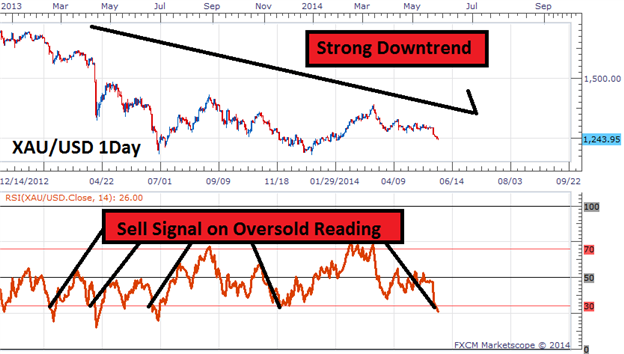
One of the most overlooked ways we can use RSI in trending environment is to sell into oversold values. This style of trading may seem counter intuitive at first, but it is very similar to trading a breakout strategy. As price continues to decline and work to create new lows RSI should move to lower lows as well. Traders watching this momentum can actually institute new trades when RSI moves below 30 (Oversold). The Daily Gold chart below is an excellent example of this technique at work. Instead of buying an oversold crossover, traders will look to sell as soon as RSI becomes oversold.
Learn Forex – XAU/USD with Oversold Entry
How to Trade Gold in an Oversold Market
The key to using RSI in this manner is that markets must remain trending. For gold, this can continue as long as fresh lows are put in place. It is important to remember that market conditions are always subject to change. In the event that the current trend ends, RSI traders can then shift gears and begin using RSI in another format.
As you can see, RSI is a versatile indicator for timing entries in a variety of market conditions. To learn more about RSI and how it can be used in an active trading plan, sign up for the DailyFX RSI training course linked below. Registration is free, and the course will include videos, checkpoint questions and access to an advanced RSI strategy. 

Thursday, May 22, 2014

Simple Way to Avoid False Breakouts

Breakout trading can be a rewarding strategy in volatile markets, but is often plagued with fake signals and false breakouts that can discourage even the best traders. Today, we will cover what a fake breakout is and how to avoid them in our trading.
 
What is a False Breakout?
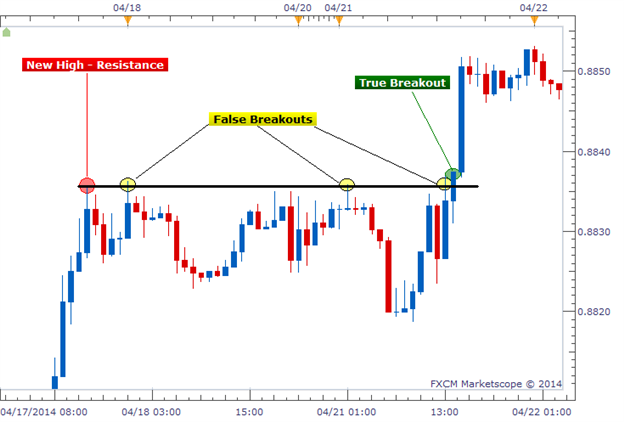
A false breakout is when price temporarily moves above or below a key support or resistance level, but then later retreats back to the same side as it started. This is the worst case scenario for a breakout trader that enters in a trade as soon as price breaks. We are immediately faced with a red arrow on our chart and the breakout we traded is looking less and less real.
Being forced to watch as breakout trades disintegrate in front of us is tough to swallow, and we are left deciding whether we should stay in and “ride it out” or close the trades for a quick loss. Neither of those options sound very appealing. So to avoid this in the future, we need to add a new rule to our existing breakout trading strategy.
 
Learn Forex: Avoiding False Breakouts
Simple Way to Avoid False Breakouts
(Created using Marketscope 2.0 Charting Platform)
 
How to Avoid a False Breakout
The solution to this problem is actually pretty simple (as depicted above). Rather than act on a trade in real time as soon as price breaks a key level, we should wait until the candle closes to confirm the breakout’s strength. So the idea of setting entry orders above or below a support or resistance levels to automatically get us into a breakout trade is not a very good one. Entry orders allow us to get “wicked” into breakout trades that never actually materialize.
On the surface, this would lead us to believe that the only way to effectively trade breakouts, is to be at our trading terminals ready to act as soon as the candle closes in breakout territory. Once the candle closes, we can then open our position that hopefully has a higher chance of success. But what if we don’t have all day to sit around and wait for breakouts?
 
Setting Alerts Based on the Candles’ Close Prices
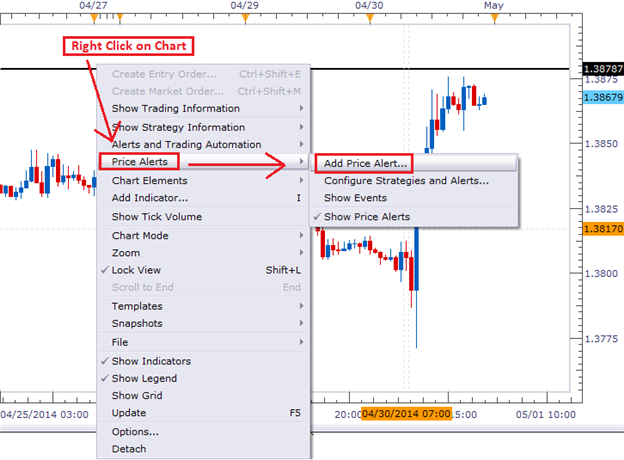
So, if physically waiting at your computer for a breakout is not an option, I recommend using a price alert that uses each candle’s closing price as its trigger. In other words, you will only receive an alert if support or resistance is broken and remains broken through the close of that specific candle. That way you can receive your alert, log in on your computer or mobile application and place the trade. To set this up, we need to right-click on our chart and select “Add Price Alert.”
 
Learn Forex: Add a Price Alert in Marketscope
Simple Way to Avoid False Breakouts
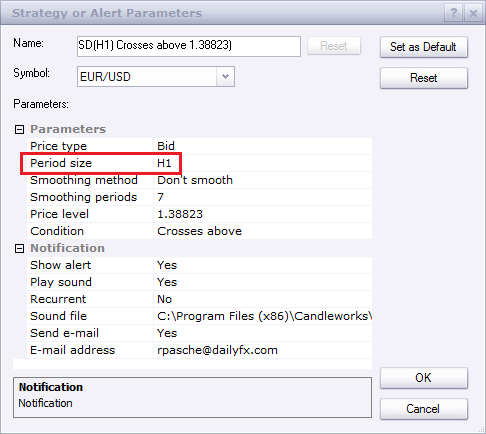
The specific price alert option we need to look at is the Period. This is where we select the size of chart we are looking at; Daily, 4-hour, 15-minute, etc. In the example below, we were looking at an hourly chart. So we selected “H1” for our period.
 
Learn Forex: Selecting the Period Size in Price Alert Menu
Simple Way to Avoid False Breakouts
 
Once selected, we will only be alerted if a candle closes beyond the price level we selected rather than alerted as soon as the price is broken in real time. For an hourly chart, that mean we could only be alerted at the top of the hour, after each bar closes. This is exactly what we were looking for.
 
Avoiding False Breakouts
This tiny tweak can make a big impact on your breakout trading. But like always, I recommend making these changes to your strategy in a demo environment before testing them with real money. You can sign up for a free FXCM demo account here.

Thursday, May 1, 2014

Top Trade Idea For May 1st, 2014 – EURJPY


It is a while since we didn’t look at the eurjpy pair and I would say that right ahead of the NFP and ECB we are having an interesting technical setup.

What you see on the chart above is the 4h time frame on the pair and one thing that strikes the eyes is an elongated flat right at the beginning of the corrective wave and from that moment on we are looking for a possible contracting triangle as these formations appear as the entire leg of a triangle or only as part of a leg of a triangle.

I would say that wave a blue there is a triple combination that is followed buy a contracting triangle as a b wave blue or a double combination for the same wave. It really makes no difference as the outcome should be the same: two corrective wave should be followed by either an impulsive move to the downside, and in this case it is a flat we are looking for, or another corrective wave that should for the c wave blue of a contracting triangle.

In both cased price should move to the downside on a break of 141.14 level and the first target should be 140, the psychological level, while the second and final target should be anywhere between 138.50 and 139 levels.

Tuesday, April 22, 2014

2 Ways to Trade a 2500 Pip Trend, Part 2: Fear of the Unknown

This is the second part of a 2 part series on trading strong trends. The first part was devoted to using a retracement strategy on the EURNZD which has been in a strong down trend for the past 11 months. Yesterday, prices did push into the resistance retracement zone. Therefore, retracement traders may be inclined to enter a position based on selling at resistance.
However, in our DailyFX Plus webinars, we frequently hear from traders who are apprehensive to place entries into the market because they fear the unknown price movements into the future. What if the strong trend ends?
That is a common emotion felt by many traders. Utilizing a break out strategy can help alleviate some of those pressures as you let the market dictate to you if it is ready to resume the trend.
A breakout is simply selling at support and buying at resistance. There are many different ways of determining support and resistance. Today, we will look at a simple method of identifying entry and exit points by using the Donchian Channel Indicator.
 
2_Ways_to_Trade_a_2500_Pip_Trend_part_2_body_Picture_1.png, 2 Ways to Trade a 2500 Pip Trend, Part 2: Fear of the Unknown
(Created using FXCM’s Marketscope 2.0 charts)
 
Here is a summary of the rules to the strategy.
  1. Filter your trades in the direction of the daily trend. We determined in Monday’s report that this trend is a strong one to the downside. Therefore, we will look to sell.
  2. Add the Donchian Channel Indicator to a 2 hour chart. Input value is 55 periods.
  3. Place an entry order to sell 1 pip below the lower Donchian channel.
  4. Place a stop loss order at the upper Donchian channel. Manually trail your stop loss so that it follows the upper channel.
  5. Exit the trade when price reaches the upper Donchian channel.
The benefit of using this strategy is that if the trend re-emerges to the down side, the market trips the entry and places you in the trade. By trading to a new low, the market is essentially stating it is ready to trade to levels not seen in quite a while. In the case of the EURNZD, it would be trading at all-time lows and therefore, furthers the case that it is in a strong trend.
Also, another benefit of a breakout strategy is that it can keep you out of some losing trades (“Breakouts: How to Stay Away from Some Losing Trades”). So there are several advantages to implementing a breakout type of strategy. The downside to the strategy is that you are entering a sell trade at a lower price and therefore, entering the trade late.
In closing, when you find yourself facing the fear of the unknown in a strong trend, consider implementing a breakout strategy. Inside DailyFX Plus LIVE CLASSROOM, we frequently discuss breakouts and how to trade them.

Monday, April 21, 2014

2 Reasons to Sell US DOLLAR

TheDow Jones-FXCM U.S. Dollar Index (Ticker: USDollar), has been quietly putting in a series of lower highs and lower lows for the past four months. Though this downtrend has been in force for a while, we believe there is still one more opportunity to sell the Greenback with a good risk to reward ratio.
Here are two technical reasons the USDOLLAR may continue to slide.
 
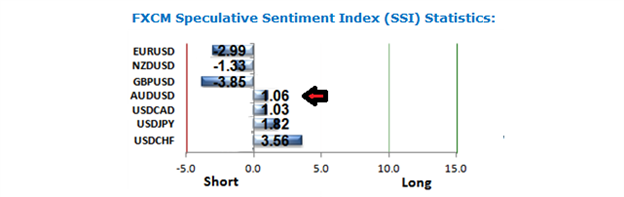
SSI Shows Retail Traders are Currency Buying USD
FXCM’s Speculative Sentiment Index (SSI) is a sentiment reading much like the COT report in futures trading or the Put/Call ratio in equity trading. SSI is a good contrarian indicator such that when a large number of traders are already positioned in a pair to one side of the trade AND if they are trading against the trend, more often, they end up being wrong on the trade.
In this case, traders are significantly positioned as US Dollar buyers. Since the trend has been towards USD weakness, these traders are fighting the trend. SSI is giving us a broad based signal that USD weakness is likely to continue.
2 Reasons to Sell USDOLLAR
Taken from FXCM’s SSI reading April 21, 2014
 
In the chart above, you’ll see how traders are positioned for Greenback strength in all of the majors, except the AUDUSD. For example, the EUR/USD shows a ratio of -2.99. This means there are nearly 3 traders short the EUR/USD for every trader who is long.
With this much broad sentiment based towards US Dollar strength, the contrarian reading suggests the US Dollar is likely to continue getting weaker.
(See FXCM’s SSI readings twice per day inside DailyFX Plus with your live account username and password. If you don’t have a live FXCM account, then you can subscribe monthly.)
 
Using Wave Relationship to Guide our Trade
The second technical reason to sell the Dollar is based on Elliott Wave analysis.
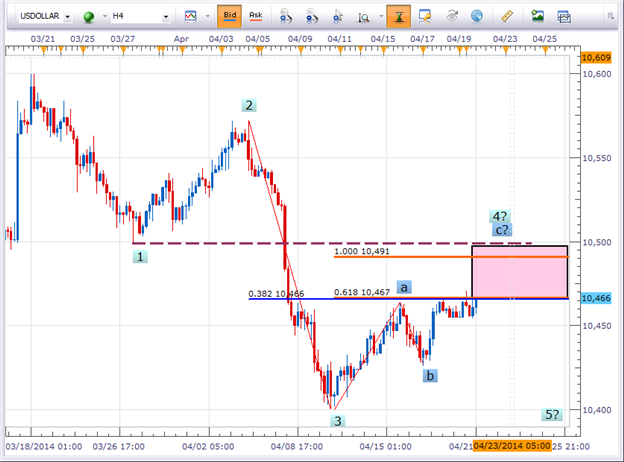
When looking at the waves of the USDOLLAR chart, prices have aggressively sold off in late March and early April 2014. It is possible that those moves down were waves 1 and 3 of a five wave sequence. If this is the pattern, then we are currently in a wave 4 counter trend retracement higher which will eventually give way to a fifth and final wave lower.
Elliott wave is a challenging type of technical analysis. Though it is difficult to learn, the benefits of even understanding it at a basic level can help you identify points on the chart to place a stop loss and take profits.
 
Forex Education: Completing the 4th wave of a 5 wave sequence
2 Reasons to Sell USDOLLAR
(Created using FXCM’s Marketscope 2.0 charts)
 
One of the rules in Elliott Wave is that wave 4 cannot enter into the territory of wave 1 in a five wave impulsive move.
If the labeling on the chart above is correct, then that means that wave 4 would not enter into the low from March 27 (see purple dotted line). If it does, then the labeling on this chart is incorrect and some other pattern is developing.
We can also use wave relationships to identify if we are getting close to an ideal entry point.
In a three wave corrective move (see the dark blue a-b-c labels above), wave c oftentimes has a length relationship to wave a. As we can see above, the orange horizontal lines illustrates where the length of wave c is 61.8% the length of wave a, a common relationship.
Also, a typical stopping point for wave 4 is at a 38.2% retracement of wave 3. Adding our Fibonacci retracement levels to the chart, we see that the 38.2% retracement of wave 3 is near 10,466.
As you can see, both the orange and blue lines are VERY close to one another. This strong wave relationship is part of the reason why prices are having a hard time moving higher.

Another wave relationship guideline is that wave 5 tends to have a wave relationship with wave 1 in terms of equality. Said another way, the size of wave 5 tends to equal the length of wave 1. That would mean wave 5 would modestly surpass the end of wave 3 and fall into the 10,375-10,400 zone.
Since this is the pattern we are favoring right now, we can enter the trade with a stop loss 1 pip above the low of March 27 (the low of wave 1). That means the stop loss on the trade would be placed at 10,500.
If we enter near the current market price and look to take profits near 10,400, that means our trading opportunity would have a 1:2 risk-to-reward ratio.
For those account holders who reside outside of the United States, you can place this trade through the USDOLLAR instrument. You should be able to see this appear on your platform.
For residents inside the United States, you can place a basket trade. There are several benefits to trading a currency rather than a pair. The Mirror platform allows you to place a US Dollar Sell Basket with one click. You can register for a free Mirror practice account if you would like to try it out.

Friday, April 18, 2014

Technical analysis: EUR/USD indecisive but trend is clear

When you take a step back it’s easier to see the bigger picture and it EUR/USD the trend is undeniably higher over the past year.
The crisis in Europe is over and the recovery has been driven by investment flows. Signs continue to point to a better economy and ECB jawboning is losing effectiveness.

The past few days have show some indecision and that could mean a retest of the trend since last July. Key reports will be Eurozone consumer confidence Tuesday and the Markit PMI a day later.

Euro technical analysis April 18 2014

How to Catch Swings in the Forex Market

Of all of the different ways that traders can approach speculation in markets, Swing Trading has to be one of the more interesting.
Scalping or day-trading is largely dependent on momentum. Longer-term trading is generally dependent on data flow or macro-economic events. But swing traders generally have a plethora of opportunities, whether markets are in long-term trends or not.
We discussed this style of trading with recommendations for time frames to utilize and entry protocols in the article, The Four Hour Trader. In this article, were going to take a closer look at the types of price action events that will often take place at these swings, giving the trader the opportunity to implement a strong risk-reward ratio on the entry of the trade. 
 
The Benefit of Price Action as an Indicator
New traders will often ask what drove that move in EURUSD? Or Why did Sterling go down? And if you look hard enough, you can almost always find a reason. Most of the financial media makes a living on the explanation behind those reasons. But the fact-of-the-matter is that this hindsight type of analysis is really simple after-the-fact; but rarely relevant before-hand. And as traders, we need to be in the position before the reasons take place, so this type of hindsight is relatively worthless.
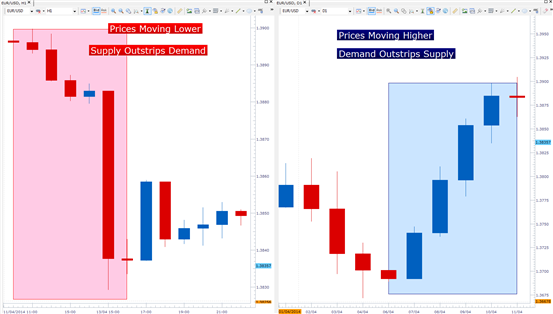
Almost every price movement in market can be boiled down to once simple factor: Supply and Demand; thats it.
If there are more buyers than sellers, then price will go up. And if there are more sellers than buyers, price will go down. This relationship is exactly why markets work. Prices reflect what the market is willing to pay. 
 
Changes in Supply and Demand create price movements
How_to_Catch_Swings_body_Picture_2.png, How to Catch Swings in the Forex Market
Created with Marketscope/Trading Station II.
 
This is why technical analysis can be so valuable: It can strip out the whys’ and focuses on the what.’
One of the downsides of technical analysis is that most indicators are lagging the market, so it just obscures traders from the current supply/demand impact on the market; and this is why price action can be so incredibly valuable.
Price action, or the study of analyzing price and price alone in a traders analysis is one of the most pure ways of performing technical analysis because it does not include any indicators that are lagging the market. If youd like to become more familiar with the study of price action, the article Four Simple Ways to Become a Better Price Action Trader can certainly help you get started. And for more advanced study, The Forex Traders Guide to Price Action can take that education a step further. 
 
Using Price Action to Catch Swings
Because price action is giving traders a direct view of the supply and demand in a market at a given point in time, traders can potentially get an early indication that a swing or reversal in prices may be near.
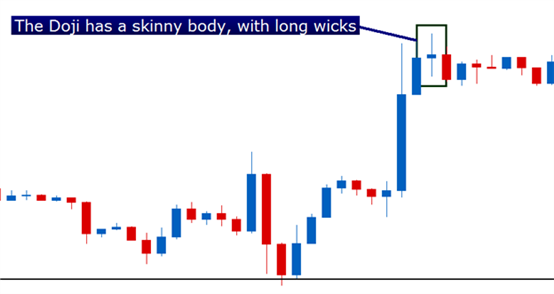
When market display indecision, this is showing that supply and demand is roughly equal at that moment in time. This will often show as a series of candlestick formations such as the Doji , or Spinning top formation. 
 
Indecision formations highlight potential turning points
How_to_Catch_Swings_body_Picture_7.png, How to Catch Swings in the Forex Market
 
But this indecision may take a while to play out before prices actually reverse in the other direction. In many cases, multiple spinning tops or dojis can show up before prices actually reverse. But the benefit of this prolonged period of indecision is that it highlights to traders that the supply or demand in that pair may be at a turning point.
In the article The Most Important Price Action Formation is Indecision, we look at a variety of different indecision candlestick formations that can potentially clue a trader into an upcoming reversal period.
Perhaps most importantly with indecision and swing-trading formations, traders can look for strong risk-reward ratios in an effort to avoid the Top Trading Mistake of losing so much when wrong; and making so little when correct.

Thursday, April 17, 2014

Develop a Scalping Strategy in 3 Steps

Talking Points:
  • Scalping strategies can be broken down into three components
  • Always consider market direction and the trend
  • Plan entries around retracements or breakouts
Many traders want to implement a scalping strategy, but don’t know where to get started. The truth is, you can develop a simple scalping strategy in as little as three steps. Today we will review the three components of a scalping strategy. Let’s get started! 
 
Find The Trend
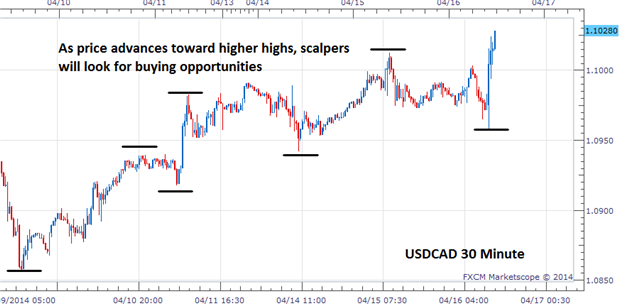
The first step to scalping is finding the trend. Finding the trend is vital because it helps create our trading bias for a currency pair. For example, if the pair is creating a series of higher highs, traders would only want to look for buying opportunities. This is opposed to a graph that is moving towards lower lows, when sell positions are preferred.
Using the example below, we can see the USDCAD has been trending upwards with the creation of a series of higher highs and higher lows. This means that scalpers should look for opportunities to buy the market. 
 
Learn Forex: USDCAD 30Min Trend

Develop-a-Scalping-Strategy-in-3-Steps_body_Picture_2.png, Develop a Scalping Strategy in 3 Steps

Wednesday, April 16, 2014

The 3 Step No-Hassle Breakout Strategy

Talking Points:
  • Volatility breeds breakout trading opportunities.
  • 24-period Donchian Channel on an Hourly chart can give us medium term trade entries.
  • Stops can be set opposite of the channel break using 1:2 risk and reward ratio.
While trend trading makes up the bread and butter of my personal trading account, I also employ a breakout strategy that has yielded positive results. It’s true that breakout strategies require more time and energy than longer term trend strategies, but breakouts are easy to trade when you have set rules to follow.
The ideal breakout trade is on a currency pair that has exhibited a high level of volatility and then breaks a key support or resistance level. Pairing this type of opportunity with a sound money management plan can result in a trading edge. Today, we are going to lay out this simple, no-hassle breakout strategy in 3 steps.
Step 1: Look for Volatility
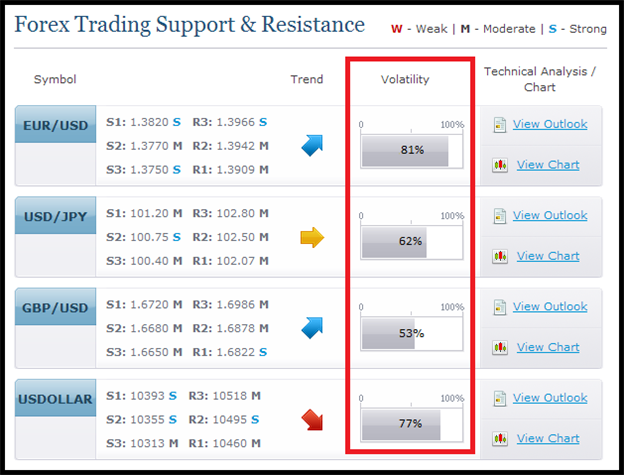
Not all market conditions are ripe for breakout trading. We need to first find the pairs that have shown the most volatility. While you can independently figure out what pairs are the most volatile by ‘eye balling’ it, we prefer using DailyFX’s Technical Analysis page.
 
Learn Forex: DailyFX Technical Analysis - Volatility
The-3-Step-No-Hassle-Breakout-Strategy_body_Picture_3.png, The 3 Step No-Hassle Breakout Strategy
(Copied from DailyFX.com’s Technical Analysis page)
 
The image above shows volatility highlighted in red. A 0% reading means a pair has shown almost no volatility while a reading of

Tuesday, April 15, 2014

Chart Of The Day For April 15th, 2014 – EUR/USD

EUR/USD Technical Strategy: Pending Short
    Support: 1.3835 (23.6% Fib exp.), 1.3793 (38.2% Fib exp.)
    Resistance: 1.3905 (Apr 11 high)

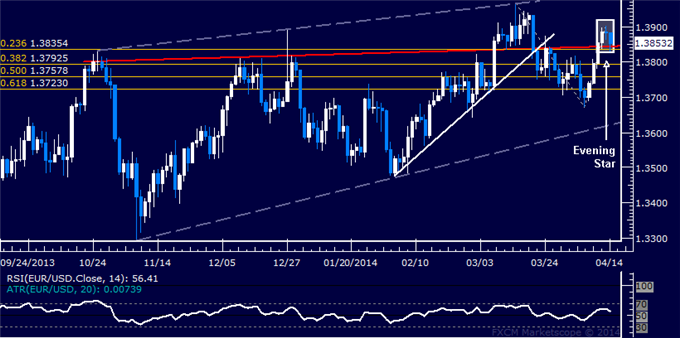
The Euro may be carving out a top below 1.39 to the US Dollar after prices put in bearish Evening Star candlestick pattern. A break below support at 1.3835, the 23.6% Fibonacci expansion, initially exposes the 38.2% level at 1.3793. Near-term resistance is at 1.3905, the April 11 swing high.

Our long-term fundamental outlook calls for a bearish bias on the Euro against the greenback. We will opt against entering short at present however with prices sitting too close to near-term support to justify a trade on risk/reward grounds, waiting for a more attractive setup to present itself.


Monday, April 14, 2014

Top Trade Idea for April 14th, 2014 – EUR/CAD

While there continue to be mixed signals in the forex market in terms of correlations, there still exist basic technical set-ups.  EUR/CAD being one to consider.

EUR/CAD is likely to run into resistance into the 1.5150 area where short positions make sense.  Stops are tight, just above 1.5184 and a downside target of 1.5080


US Dollar Chart Setup Hints at Bounce, SPX 500 Hits Two-Month Low

Talking Points:
  • US Dollar Candlestick Pattern Hints at Recovery Ahead
  • S&P 500 Sinks to Two-Month Low, Sellers Target 1800
  • Gold, Crude Oil Rise to Challenge Technical Resistance
Can’t access to the Dow Jones FXCM US Dollar Index? Try the USD basket on Mirror Trader. **
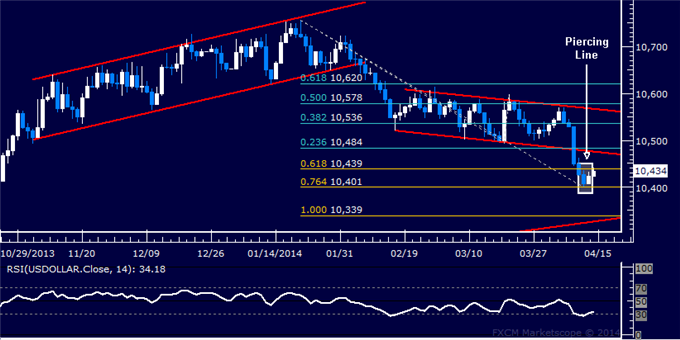
US DOLLAR TECHNICAL ANALYSISPrices put in a bullish Piercing Line candlestick pattern above support at 10401, the 76.4% Fibonacci expansion, hinting a bounce may be ahead. Breaking above the 61.8% expansion at 10439 exposes the 10475-84 area, marked by the underside of a previously broken falling channel and the 23.6% Fib retracement. Alternatively, a reversal downward below support aims for the 100% expansion at 10339.
US-Dollar-Chart-Setup-Hints-at-Bounce-SPX-500-Hits-Two-Month-Low_body_Picture_5.png, US Dollar Chart Setup Hints at Bounce, SPX 500 Hits Two-Month Low
Daily Chart - Created Using FXCM Marketscope 2.0
** The Dow Jones FXCM US Dollar Index and the Mirror Trader USD basket are not the same product.
 
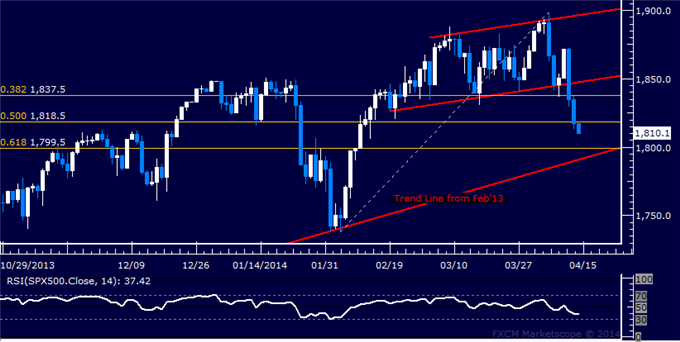
S&P 500 TECHNICAL ANALYSIS – Prices continued downward as expected, breaking support at 1818.50 marked by the 50% Fibonacci expansion to expose the 61.8% level at 1799.50. This barrier is reinforced by a major rising trend line barrier set from February 2013 at 1790.70, with a daily close below that hinting a major reversal is at hand. Alternatively, a back above 1818.50 targets the 38.2% Fib at 1837.50.
 
US-Dollar-Chart-Setup-Hints-at-Bounce-SPX-500-Hits-Two-Month-Low_body_Picture_6.png, US Dollar Chart Setup Hints at Bounce, SPX 500 Hits Two-Month Low
Daily Chart - Created Using FXCM Marketscope 2.0
 
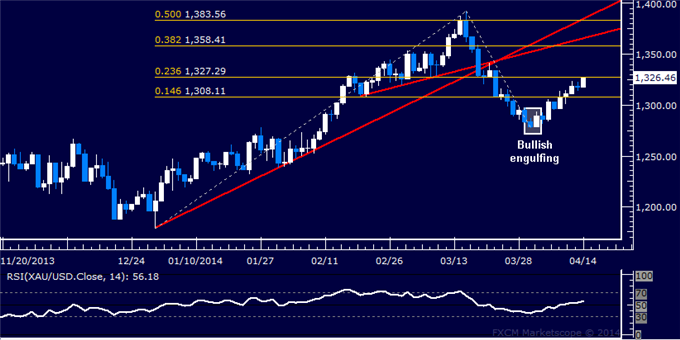
GOLD TECHNICAL ANALYSIS – Prices turned higher as expected after putting in a Bullish Engulfing candlestick pattern. Buyers are now testing resistance at 1327.29, the 23.6% Fibonacci expansion, with a break above that exposing the 38.2% level at 1358.41. Near-term support is at 1308.11, the 14.6% Fib. A reversal back below that targets the April 1 low at 1277.00.
US-Dollar-Chart-Setup-Hints-at-Bounce-SPX-500-Hits-Two-Month-Low_body_Picture_7.png, US Dollar Chart Setup Hints at Bounce, SPX 500 Hits Two-Month Low
Daily Chart - Created Using FXCM Marketscope 2.0
 
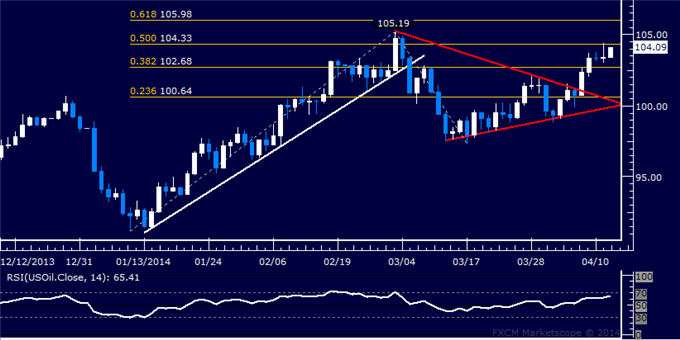
CRUDE OIL TECHNICAL ANALYSIS – Prices broke higher as expected out of a Triangle chart formation. Buyers are testing resistance at 104.33 marked by the 50% Fibonacci expansion, with a break above that exposing the 61.8% level at 105.98. Near-term support is at 102.68, the 38.2% Fib, followed by the 23.6% expansion at 100.64.
US-Dollar-Chart-Setup-Hints-at-Bounce-SPX-500-Hits-Two-Month-Low_body_Picture_8.png, US Dollar Chart Setup Hints at Bounce, SPX 500 Hits Two-Month Low
Daily Chart - Created Using FXCM Marketscope 2.0

Sunday, April 13, 2014

3 Price action strategies for forex traders

Price action strategies differ from technical led strategies as they do not rely on signals from technical indicators. Such signals can be problematic as they are often followed by thousands of other traders around the world. 

Price action strategies, on the other hand, are subjective and are drawn from a traders own perspective on the market. This causes it’s own problems as price action strategies can therefore be hard to define.

Nevertheless, many traders swear by price action techniques and here are 3 classic types.

Head and shoulders

Head and shoulders patterns form when a currency moves towards a type of ridge before moving higher once more, only to drop back towards the ridge. The two ridges are therefore the shoulders and the higher price point is the head.

What this indicates is a market that is struggling to move past the higher price levels so it’s a bearish sign. The pattern becomes even more bearish if the price moves underneath the shoulder line, and when it does a sell order should be entered into the market.

Pin bars

Pin bars, also known as dojis, are a type of candlestick price action pattern that help traders judge the momentum in the market and they can work both as reversal indicators and confirmation signals.

Pin bars occur when a market moves up or down fairly strongly, but then cannot hold onto those gains/losses. The market ends up pretty much back where it started and the candlestick ends up looking like a pin head.

It’s a classic sign that traders are winning the battle on only one side of the trend so indicates that the trend will carry on in that direction.

Wedge pattern

A wedge pattern can often be drawn onto a price chart to show a market that is converging and therefore readying for a breakout. Wedges are essentially triangle patterns and can also be called ascending, descending or bilateral triangles.

The wedge or triangle pattern is drawn from a significant high and low to a much more recent high and low. This pattern encompasses the whole of the recent price action and shows a market that is coming together in a consolidation phase.

The beauty of the wedge pattern is that the closer the two lines get to one another, the greater the inevitably of a breakout move. Since when the two lines come together, to form what is known as an apex point, the market will have nowhere to go but break out.

Bitcoin Exchange MtGox to Spend $40 Million on Restart

Bitcoins are trading slightly up today. On BTC-E, buying one piece of the virtual currency will set you back $419.7, 2$ more than yesterday. On BitStamp, purchasing the same amount of btc costs $424.9.


According to an unconfirmed translation of Japanese court documents, failed bitcoin exchange MtGox is looking to spend an astounding $40 Million on restarting operations. It is unclear if the sum will come out of the 200,000 bitcoins that the firm ‘’found’’ back on March 20th, or if the funds will be infused by an outside investor. The eye-popping figure sparked criticism among MtGox clients and creditors.

Here are some interesting excerpts from the website GoxDox.org , where the translation is located:

‘’after expenses for restarting, only ten percent of the value of the company will be left in the form of assets. This must mean they believe it necessary to spend more than half the 200k bitcoins to get the company restarted as an initial matter. Someone else can clearly do better.’’

‘’Their security expert has no background in security.  They have not named a general counsel.  They want to take all the bitcoins, fund our accounts pro rata, but not let us have them for a year.  The most sensible thing they mention is that Mark K can’t be part of management and has to give up his shares, but we all saw this coming.’’

Saturday, April 12, 2014

Range Trading Basics

Talking Points:
  • In the absence of a trend, trade market ranges
  • First identify key levels of support & resistance
  • Manage risk with a stop, in the event that price breaks
Many traders consider themselves trend traders. But what happens when the market loses its direction? Instead of being deterred by sideways price action, traders should develop a plan of action for ranging markets. Today, we will review how to identify a trading range, and an easy way to approach trading trendless markets. Let’s get started!
 
Find The Range 
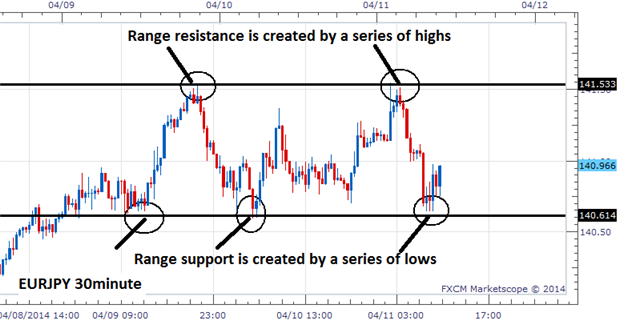
The first task of range trading is to find the range! This process can be easily done by connecting a series of highs and lows with a horizontal trend line. The key is to find two points to connect on your graph. Once found, these values can be extrapolated to form a line of resistance and support, with the area in between defined as our trading range.
Below we can see an example of an active range on the EURJPY. Resistance has been formed by connecting two previous highs near 141.50. Likewise, support has been defined by connecting a series of lows near 140.60. The distance between these two points is a respective 90 pips which the range trader will look to take advantage of as long as support and resistance remain in place. 
 
Learn Forex: EURJPY 30Min Trading Range

Planning an Entry
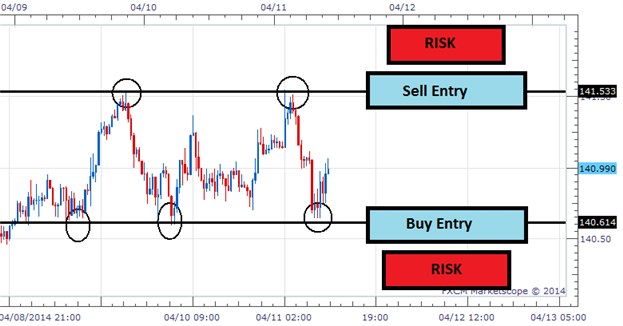
Once levels of support and resistance have been found, traders can begin planning to enter the market. One benefit of range trading is that traders can take a non-directional look at the market and place both buy and sell orders. Since price is moving sideways, orders to buy will be placed as close to our support line as possible. If price reaches resistance, the same stance can be taken but this time range traders will have a preference to sell the market.
Traders can set entry orders near support and resistance, or even trade with market orders. If you have limited time to trade, entry orders would be the preferred method of range trading. Entry orders will remain pending until price touches the designated level, prior to execution. Market order traders may use a system of confirmation before entering. Confirmation signals may include identifying a candle pattern or incorporating an oscillator signal prior to entering the market. 
 
Learn Forex: EURJPY 30Min with Range Entries
Range-Trading-Basics_body_Picture_1.png, Range Trading Basics
 
Manage Risk
As with any trading plan, range traders need to consider risk. The major risks associated with trading ranges, comes from a potential breakout of support and resistance. In the event that support breaks, any buy positions should be vacated. As well, if resistance breaks, traders should consider the range invalidated and exit any sell orders. This process can be handled through the use of stop orders beneath levels of support or above key points of resistance.
Now that you are familiar with the basics of range trading, it’s time to practice your new skills. You can get started identifying and trading ranges with a Free Forex Demo with FXCM. This way you can develop your trading skills with the market in real time!

Friday, April 11, 2014

Top Trade Idea For April 11th, 2014 – GBP/JPY

Many traders have a favourite indicator or signal. Others try to remain agnostic, choosing the most appropriate signal for market conditions. However, many traders agree that several indicators pointing in the same direction is a stronger trade signal.

A potential triangle break, through the “big figure” of 170.00, would likely see the MACD cross as well. Looking for a swing on this signal cluster, traders may consider selling at 169.85, with a stop above the triangle top around 173.00, and a target just above support around 163.90. Shorter term traders could look at selling at the same level, with a tighter stop just above 170.00, seeking to trail a profitable trade down.

A factor in considering this trade is that it is against the consensus fundamentals of a strengthening Pound and a weakening Yen. While putting on the trade is counter intuitive, should technical selling kick in there is potential for an exaggerated move.

How to Reap Larger Rewards

Talking Points:
  • In the Top Trading Mistake, we saw how risk-reward ratios can have a large impact on performance.
  • Traders should look to minimize their risk on each trade, using stops to reinforce the ‘maximum loss.’
  • Traders can then look to maximize reward potential with trade management.
Have you ever had that trade that, at least initially, looked like it was going to work out better than you had initially hoped for?
You keep your limit on the position, and comfortably walk away from the trade knowing that your analysis, your strategy, and your hard work have all paid off. It feels as if it’s as good as ‘money in the bank.’
When you come back to check on the position, counting the profits in your head you realize that something has gone terribly wrong. The trade that once looked like a sure-fire win has turned around, and ran straight to your stop-loss.
You look at your equity; dejected from this ugly and unwelcomed surprise, and it finally sinks in: This trade that once looked like it was ‘in the bank’ actually turned into a loss. And your equity stares you in the face with only a fraction of the funds that were previously there. Disappointment reigns supreme.
This is one of the most unsavory aspects of trading. Dealing with this type of dejection isn’t easy for most in a game where rejection is a common (and regular) part of reality. This is also psychological torture, and leads many to fall victim to the Top Trading Mistake.
Most rationale people will respond accordingly… and the next time they see profits on the table they take them off quicker than your or I can say ‘close.’
But is this really the best thing to do?
Is there no other way to proactively plan around this issue?
Do you think the titans of this industry, be it Paul Tudor Jones or Warren Buffett, skirmish to quickly take profits out of fear of watching a winner become a loser?
No. As a matter of fact, Mr. Buffett has a very famous quote on this very topic:
‘Be fearful when others are greedy, and be greedy when others are fearful.’
In this article, we’ll attempt to teach you how to do that.
Why Taking ‘Quick’ Profits Can be Destructive
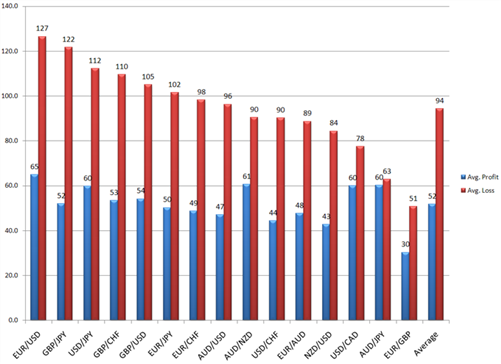
The Top Trading Mistake is inverse risk-reward ratios, or to put it simply: Traders can lose so much more when they are wrong than they make when they are right that even winning 60 or 70% of the time produces net losses to the portfolio.
DailyFX did an extensive research study on this very topic, and this was found to be The Number One Mistake that Forex Traders Make, authored by Mr. David Rodriguez. They take very small profits, and very large losses.
Traders took far bigger losses when they were wrong, than they made when they were right
how-to-reap-rewards_body_trade_pips.png, How to Reap Larger Rewards
Taken from The Number One Mistake Forex Traders Make, by David Rodriguez
This is indicative of traders entering positions without a plan for exit. Traders initiate a position for any number of reasons, whether they be technical, fundamental, spiritual, whatever; and they hope for the best.
When that doesn’t pan out, they scurry around the trade leaving their fate up to the ability to react in just the right way at just the right time. This is often a practice in futility.
More regularly, what happens when the trade moves in their favor is that they quickly close the position out. Being fearful that this gain might turn around and become a loss, most traders get an element of fear when, as Warren Buffett points out, they should be greedy.
On the other side of the matter, if the position moves against them, they often hold on. They want to win, and this is very natural. This is a trader being greedy when, in fact, they should be fearful. Unfortunately, this story often gets uglier from here. As the position moves further against them, many traders will dig their heels in even deeper.
‘Price has always come back to XYZ level, I just need to be patient.’
Oh ya? Tell that to the folks that bought GBPJPY at 250.00 in 2007.
Stops can keep you out of very bad positions
how-to-reap-rewards_body_Picture_2.png, How to Reap Larger Rewards
Created with Marketscope/Trading Station II; prepared by James Stanley
A quote from John Maynard Keynes on the matter: “The market can remain irrational far longer than you can remain solvent.”
Taking quick profits is so dangerous because these smaller profit amounts can’t offset larger losses. And because the future (and price movements are unpredictable), traders have to be prepared to lose on any individual position.
This is Where the Plan Comes In
The maximum loss a trader is willing to take should be calculated before any trade is ever triggered. Decide at what point you want to exit the trade because that idea didn’t work out. This is the first part of learning how to lose properly.
Provided that traders are using moderate-to-lower levels of leverage (which was our Top Trading Mistake #2), any one loss shouldn’t have a huge impact to a trader’s account.
Once the maximum loss is set for the position, the trader can place a stop at that level so that the trade will automatically close if that price is hit in the market. This is like packing your parachute before you go skydiving; or filling your oxygen tank before scuba diving.
The stop is what helps you stay alive in markets, and prevents one trade from taking 20 or 30% of your capital away on any one, individual idea.
After the maximum loss has been set, the trader can then start plotting the profit-side of the position. As recommended in Traits of Successful Traders, the minimum reward should be at least as large as the initial stop.
So, if your stop is 150 pips away from your entry price, the minimum reward should be at least 150 pips away from the entry.
But just as Warren Buffet said, traders should be greedy when others are fearful: So, should you really take that profit just because you realized a 1-to-1 risk-to-reward ratio?
No. This is when others are fearful; fearful of failure and fearful that the position will turn around against them and run to their stop.
Save your fear for positions that lose money. When a position works in the way that you had wanted, and your hypothesis for triggering the trade is proven correct: This is the time to start being greedy.
How to Have Your Cake and Eat it Too
Traders need to realize that regardless of when they entered the trade, or how much of a profit or loss has been accumulated – future price movements are always unpredictable.
There is no ultimate ‘right’ answer as to whether any one trade should be completely closed out with profits taken off-of-the-table, or whether it should be allowed to run so that bigger profits might be obtained.
Instead, traders can utilize a series of trade management techniques to try to take advantage of either situation, and once again having a plan before triggering the trade can assist.
Traders can look to scale out of winning positions as prices move in their favor, closing a portion of the trade as prices move more aggressively in their favor. This way, traders can take some profit off-of-the-table so that in the worse-case-scenario (as we examined at the beginning of this article), they have something to show for their work.
Learning to scale-out of a position can be rather complicated, so I highly recommend trying this type of trade management on a demo account before ever using it in a live trade. Demo accounts are free, and remove the risk of financial loss. I fully realize that trading demo dollars isn’t nearly as fun as having money on the line, but trading should be about profitability; not fun. Click here to sign up for a free demo account through FXCM.
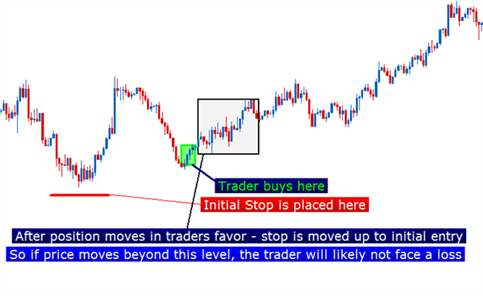
A break-even stop can also be utilized so that in the event that price reverses on the remainder of the position, a loss doesn’t wipe away the accumulated profit.
A Break-Even Stop Can Function as Protection on the Remainder of the Position When Scaling-Out
how-to-reap-rewards_body_Picture_1.png, How to Reap Larger Rewards
Taken from The Break-Even Stop, by James Stanley
After the break-even stop has been set, traders can begin to discount the fear losing money on the trade. Once again, this is where greed, and not fear, should guide the trader’s decisions.
As prices continue moving in the direction the trader is looking for, additional parts of the position can be closed. If prices do reverse, the break-even stop is there to take the position out at the original entry price.
Most importantly, this allows a trader to prevent fear from taking away profit potential. If the trade has more upside left, the trader is in a position to capitalize on that by scaling-out of the winning trade as prices move in their favor.
And what if price never moves in their favor? Well, that’s what the initial stop is there for. Future price movements are always unpredictable, whether we’re in the trade already or not. The best we can do as traders and as human beings is to try to get the most out of each situation without losing too much on any one idea.
Thursday, April 10, 2014

Top Trade Idea For April 10th, 2014 – GBP/USD

This week being Bank of England’s week, we will have a look at gbpusd or the so called “cable”.

What we have above is the four hours chart and you can call that move to the upside as you wish but no impulsive move. Therefore, we should look for corrections and, at this very moment of time, it looks like a double combination, with an x wave that connects two different corrective waves that point to the upside: a flat an a zigzag.

I would say at the highs there we ended a wave a blue, and now we should head for a b wave blue that should go minimum 61.8% when compared with the previous wave a but we are preparing to book the profits a bit earlier.

Our recommendation will be to sell a move below 1.6600 area with 1.6820 stop loss and three different targets for booking 1/3 at each: 1.6459, 1.6260 and 1.5950 as the final target, just shy above the 61.8% as buyers are expected below.

That b wave ping to the upside is the end of a zigzag and from a technical perspective, we have two possibilities, both pointing towards the same direction:
one would be the market will for a flat and now we should see a five waves structure for c wave pink, in which case our entry will come;
the other would be that this zigag to the upside is actually only wave a of a contracting triangle that should break lower and the whole pattern from the lows will be called a triple combination. In this case our trade will be triggered only after the triangle will break lower as the entry is below the possible second x wave pink.

It remains to be seen if markets will confirm our scenario.

How to Determine Your Position Size

Talking Points:
  • Determining trade size is critical to risk management
  • Larger lot sizes increase profit and losses per pip
  • Use the Risk Management App to simplify calculations
Many Forex scalpers have plans for stop placement, but often forget about position size! This can be devastating to a traders account in the event that too much leverage is used when an inappropriate lot size is selected. The good news is this issue can be avoided with a few easy steps and calculations! Today we will review how to select the correct lot size for your trading plan.
 
Determine Stop Placement
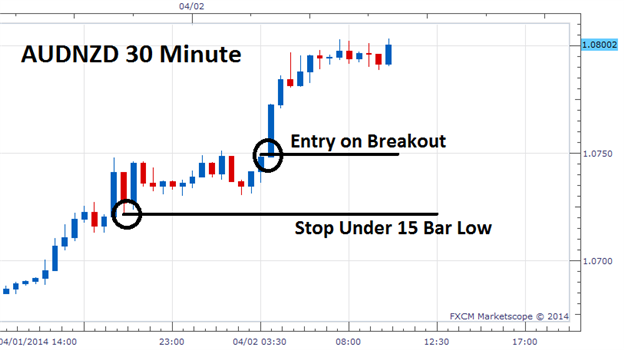
The first step in determining lot size is to plan your stop placement. While this may sound counter intuitive, this step must be taken before we proceed. There are virtually limitless ways to determine where to place your stops which include finding market swings, using volatility indicators, or selecting an arbitrary value. Regardless of how you decide to place your stop, once set, remember the value of pips your stop is away from your entry. Keep this value handy as we move on to the next step!
Learn Forex: AUDNZD with a sample 15 Bar Stop
How-to-Determine-Your-Position-Size_body_Picture_3.png, How to Determine Your Position Size
 
Determine Risk %
The next task is to determine how much you wish to risk as a percentage of your account. Normally traders are recommended to employ the 1% rule. This means that traders should never risk more than 1% of their account balance on any one trading idea. That means using the math above, if you are trading a $10,000 account you should never risk more than $100 on any one positions. Keep this total in mind as well, as we work to our final goal of determining the appropriate position size.
How-to-Determine-Your-Position-Size_body_Picture_2.png, How to Determine Your Position Size
Evaluate Pip Cost and Lot Size
Next we will need to determine pip cost. Pip cost by definition is how much you stand to earn or lose per pip, as a trade moves in and out of your favor. This number becomes critical when we begin to evaluate trade size and risk on an individual position, because the larger the position we trade the more we stand to lose per pip. So how big should our trade size be?
The key is to take your total risk (1% of Balance) and divide this value by the number of pips you are risking. The result is the value you should be risking per pip to meet this requirement. Traders can then adjust their lot size to fit the pip cost needed. The example above shows a trade with a sample $10,000 balance. If we wanted to risk $100 (1% of balance) on a 10 pip stop, we would need to use a 100k trade size. If we lose $10 a pip for a 10 pip stop loss this puts our total loss at $100 or 1% of our $10,000 balance.
How-to-Determine-Your-Position-Size_body_Picture_1.png, How to Determine Your Position Size
 
Risk Management App
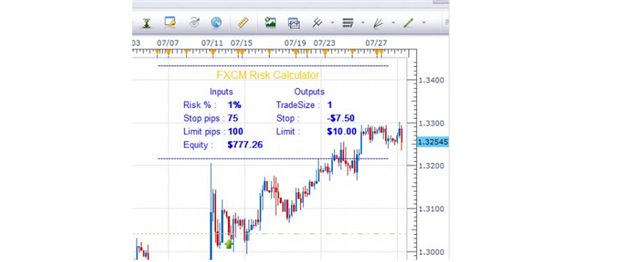
Now that you know how to calculate your proper trade size, let’s simplify the process. FXCM has an application available for the Marketscope 2.0 charting software designed to help determine how much risk is being assumed on any one particular trade. Once added to your chart, the FXCM Risk Calculator, as depicted above, has the ability to help a trader calculate risk based off of trade size and stop levels.
We walk through the application, as well as how to manage risk in several videos embedded into the brainshark medium. After clicking on the link below, you’ll be asked to input information into the ‘Guestbook,’ after which you’ll be met with a series of risk management videos along with download instructions for the application.

Wednesday, April 9, 2014

FOMC Meeting Minutes: 3 Key Points and the USD-Negative Reactions


Federal-Reserve-Logo

The market started the week softening the USD across the board. We saw rallies in EUR/USD, GBP/USD, AUD/USD, and declines in USD/JPY, USD/CHF, and USD/CAD just to name a few USD-crosses. Traders were walking back recent USD-strength, one that was partially based on expectations that the Fed is considering hiking rates in 2015.
The FOMC minutes had 3 main points:
1) Economy is still slow in recovering, and China’s downturn won’t help.
2) Members walking back some optimism shown at the turn of the the year – recent soft data is not just due to the cold. Thus low interest rate might be longer than expected, maybe through 2015.
3) Inflation is low and is a concern that can hold back any interest rate hike.
This provides some basis for the USD-weakness already put in earlier this week. The minutes revealed a committee that wanted to stay grounded and was concerned it was getting ahead of itself in projecting rate hikes in 2015 and 2016. Thus the minutes were relatively dovish compared to recent hawkish developments. The greenback was already sliding – the question is whether it will extend.
Let’s take a look at the USD/JPY, EUR/USD and GBP/USD.

USD/JPY vs. EUR/USD and GBP/USD developments:
USD-weakness looks best for EUR/USD and GBP/USD. However, the JPY is also weak, and USD/JPY has been bullish. Thus, it will take more to continue the uptrends in EUR/USD and GBP/USD than to reverse the prevailing uptrend in USD.
USD/JPY:
usdjpy 4h chart 4/9
(usdjpy 4h chart 4/9)
The USD/JPY has been very bearish this week, and today’s minutes confirm that the market’s concern was being priced in.
If USD/JPY can’t push below 101.50, it will maintain a slightly bullish bias within the consolidation mode. A break below that extends the bearish outlook first to challenge the 2014 low at 100.75, towards the 100 psychological handle.
It will be tough to keep a bullish outlook for USD/JPY after the dovish minutes, UNLESS the pair rallies back above some common resistance in the 102.80-85 area.

The EUR/USD and GBP/USD are both being boosted because of the weak USD.
EUR/USD
eurusd 4h chart, 4/9
(eurusd 4h chart, 4/9)
EUR/USD broke above the 1.38 resistance where it stalled earlier this session. The USD-negative reaction also pushed it above a falling channel resistance, thus reflecting bullish continuation. It’s next challenge will be to clear the 2014-high near 1.3966.
GBP/USD
gbpusd 4h chart, 4/9
(gbpusd 4h chart, 4/9)
GBP/USD is now about to test the 2014 high at 1.6822. Above that, cable’s next challenge will be the 2009 highs, situated in the 1.69-1.7050 area. If we get a throwback, look for support in the 1.6650-1.67 area. At this point, a break below 1.6550 will be needed to take away the strong bullish continuation outlook.